
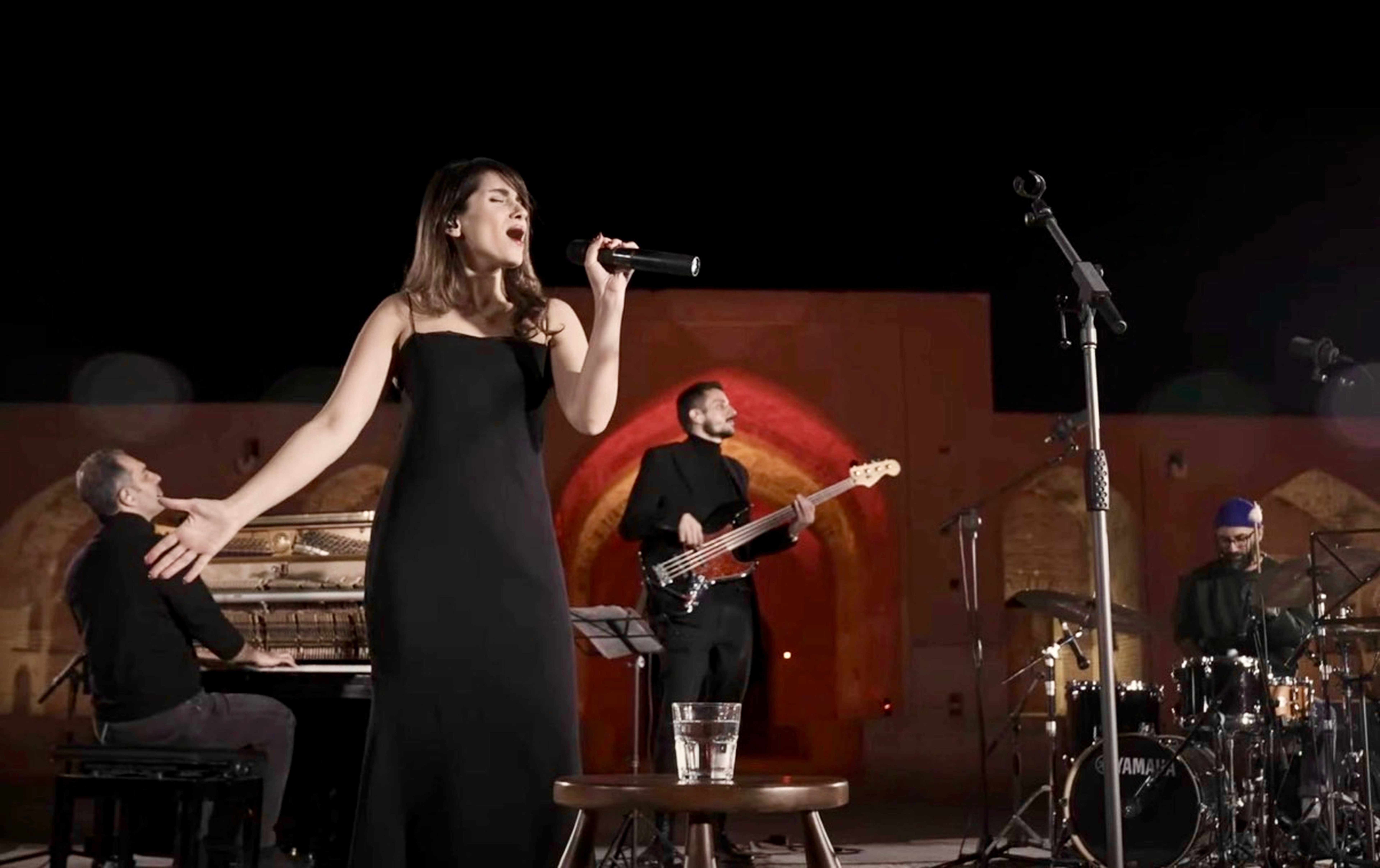
“I, Parastoo, am a girl who wants to sing for people I love. This is a right I cannot close my eyes to; to sing for a land that I love dearly.
Here, in this corner of our beloved Iran, where our history and myths intertwine, listen to my voice in this imaginary concert and dream of this beautiful homeland…”
Parastoo Ahmadi stands among the Iranian women who have challenged the boundaries imposed on them through art, voice, and civil courage. Born in 1997 in the northern city of Nowshahr, Iran, and trained in film directing, she’s a singer, composer, and filmmaker whose name has become synonymous with artistic resistance, the fight against compulsory hijab, and women’s right to sing and be seen.

Before becoming an international symbol, Ahmadi did something that should be natural and unquestioned for any artist: she sang. But under the Islamic Republic, a woman’s voice is still treated as a crime, a woman’s body as a field of political control, and a woman’s art as grounds for a security case.
The Caravanserai Concert
Her profile first rose during the 2022 Woman, Life, Freedom protests, when footage circulated of her performing the patriotic song “From the Blood of the Youth of the Homeland.” Then, in December 2024, she released an online concert filmed at the historic Deyr-e Gachin Caravanserai, performed without an audience, without a hijab, and livestreamed on YouTube. She wrote about it simply: she wanted to sing for the people and the homeland she loved, and called it a right she couldn’t overlook.

The video has since drawn millions of views. It wasn’t just a musical event. In a country where women are punished for choosing their clothing, dancing, singing, or simply appearing freely in public, Ahmadi’s voice became a form of protest, proof that resistance doesn’t always start with a slogan. Sometimes it starts with a voice, a song, and the decision to stand against fear.
Arrest and sentencing
Ahmadi was arrested within days of the concert’s release, along with several of her musicians, and held for questioning before being released on bail. More than a year later, in June 2026, Iran’s Qom Provincial Criminal Court handed down its ruling: Ahmadi and eight members of her production team and band were sentenced to 74 lashes each, a two-year ban on leaving the country, and a two-year ban on artistic activity. The official charge was “offending public decency” through “vulgar and immoral content.”
Among those sentenced was Tahmineh Monzavi, the photographer and videographer who documented the concert. Her inclusion shows the regime wasn’t only targeting the woman who sang, it was targeting everyone who helped film, photograph, produce, and preserve that act of freedom. Monzavi has faced this kind of pressure before: at 23, she spent a month in solitary confinement after a photo series on marginalized communities in Tehran was deemed “dangerous to society.”
Why it matters
Human rights lawyers have pointed out that singing and performing music are not actually criminalized under Islamic Regime law, raising serious questions about the legal basis for the ruling. Rights groups, including the Center for Human Rights in Iran, have called the sentence proof that conditions for women in Iran haven’t changed, regardless of the government’s public messaging.
Flogging a singer for performing without a hijab isn’t just punishment of an artist, it’s an attack on human dignity, freedom of expression, and women’s right to their own bodies and voices. The regime wants to tell women that even their voices don’t belong to them. But Parastoo Ahmadi broke that claim simply by singing.

The importance of Parastoo Ahmadi lies in the fact that she represents a generation of Iranian women no longer willing to ask permission to live, women who have stood in the streets, universities, prisons, art spaces, and their own homes to say that being a woman is not a crime, singing is not a crime, refusing the hijab is not a crime, and freedom is not a crime.
Parastoo Ahmadi continues the path of women who have resisted through art: writing, filmmaking, painting, photographing, singing, refusing to let the regime reduce them to silence, fear and obedience.

At I-WILL, we honor Parastoo Ahmadi because her story isn’t only the story of a singer. It’s the story of a woman who showed that a voice can pass through the walls of censorship. The Islamic Republic can issue flogging sentences, impose bans, and threaten artists, but it cannot erase the effect a free voice leaves on public memory.
Parastoo Ahmadi reminds us that when art is joined with courage, it becomes resistance. And sometimes the voice of one woman is louder than all the tools of repression a regime can use against her.
Watch the concert
Parastoo sang so her voice could reach the people she loves. Every view and every share carries that voice further. Watching her concert is a small act of resistance.
Leave a Reply